
OLED vs TFT: Which is Right For Your Application
Choosing the right display technology is a critical decision for any electronic product. OLED and TFT display modules are the two most commonly used solutions across industrial, medical, and consumer applications, yet they serve very different design goals.
This article provides an in‑depth comparison of OLED vs TFT display modules, covering technical principles, performance differences, application scenarios, and cost considerations — helping you select the most suitable display for your project.
1. Technology Overview
What Is an OLED Display Module?
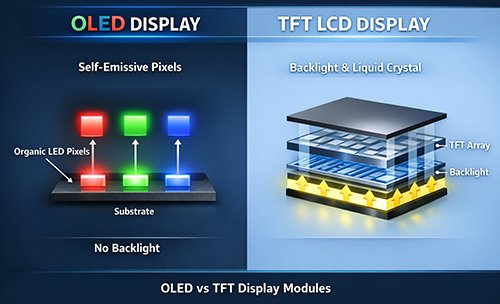
OLED (Organic Light Emitting Diode) displays are self‑emissive. Each pixel generates its own light when electrically driven, eliminating the need for a backlight.
Key characteristics:
No backlight required
True black display (pixels fully off)
Extremely high contrast ratio
Thin and lightweight structure
Common OLED module types:
Monochrome OLED (white, blue, yellow)
Color OLED
Passive Matrix OLED (PMOLED)
Active Matrix OLED (AMOLED)
What Is a TFT Display Module?
TFT (Thin Film Transistor) displays are a type of LCD technology that rely on a backlight. Each pixel is controlled by transistors that regulate light passing through liquid crystal cells.
Key characteristics:
Requires LED backlight
Bright, colorful images
Wide size availability
Mature and stable manufacturing
Common TFT module types:
TN / IPS TFT
RGB, SPI, MCU, MIPI interfaces
Capacitive or resistive touch options
2. Image Quality Comparison
Contrast & Black Level
OLED: Excellent contrast (often >10,000:1). True black with no light leakage.
TFT: Limited by backlight. Even IPS panels cannot achieve true black.
✔ OLED is superior for dark UI, night‑mode devices, and high‑contrast displays.
Brightness
OLED: Typically 80–300 nits (higher possible but affects lifespan).
TFT: Easily reaches 500–1000+ nits with high‑brightness backlight.
✔ TFT is better for outdoor or sunlight‑readable applications.
Viewing Angle
OLED: Near‑perfect viewing angles.
TFT: IPS TFT offers good angles, TN TFT is limited.
✔ OLED has a clear advantage for multi‑angle visibility.
3. Power Consumption
Power usage is often a deciding factor in embedded and portable devices.
OLED: Power consumption depends on displayed content. Dark interfaces consume very little power.
TFT: Constant backlight means relatively stable but higher power draw.
✔ OLED is ideal for:
Battery‑powered devices
Wearables
Portable medical instruments
✔ TFT suits:
Devices with continuous power supply
Large display areas
4. Lifetime & Reliability
OLED Lifetime
OLED materials degrade over time, especially blue pixels.
Typical lifetime:
20,000–50,000 hours (monochrome OLED often lasts longer)
Mitigation strategies:
Static UI design
Lower brightness
Screen refresh logic
TFT Lifetime
TFT panels generally offer:
Longer operational lifetime
No burn‑in risk
Stable brightness over time
✔ TFT is preferred for 24/7 industrial systems and long‑term fixed display content.
5. Size & Resolution Flexibility
| Aspect | OLED | TFT |
|---|---|---|
| Typical size range | 0.42″–3.2″ | 1.3″–15.6″+ |
| Resolution | Low to medium | Low to ultra‑high |
| Large display cost | High | Lower |
✔ OLED excels in small‑size displays. ✔ TFT dominates medium to large‑size displays.
6. Interface & System Integration
OLED Interfaces
I2C
SPI
Simple integration, ideal for microcontrollers and low‑pin‑count designs.
TFT Interfaces
SPI / MCU (small TFT)
RGB / LVDS / MIPI (larger TFT)
Requires more pins, higher bandwidth, and stronger MCU/SoC capability.
✔ OLED = simpler hardware ✔ TFT = higher system complexity
7. Cost Considerations
OLED: Higher cost per inch, especially for color and large sizes
TFT: More economical for medium and large displays
Cost factors include:
Panel size
Resolution
Interface type
Touch functionality
Volume requirements
8. Typical Application Scenarios
Best for:
Wearable devices
Medical handheld instruments
Smart meters
IoT devices
Low‑power embedded systems
Best for:
Industrial HMI panels
Smart home control screens
POS terminals
Automotive displays
Consumer electronics
9. OLED vs TFT – Quick Decision Guide
Choose OLED if you need:
Ultra‑low power consumption
High contrast & deep black
Compact size
Simple interface
Choose TFT if you need:
High brightness
Large screen size
Long operational lifetime
Rich colors and UI
10. Final Thoughts
There is no universal “best” display technology — only the right choice for your application. OLED and TFT display modules each offer unique strengths, and selecting the correct one can significantly improve product performance, reliability, and user experience.
If you are unsure which technology suits your project, working with an experienced display supplier can save time and development cost.
👉 Explore our OLED Display Modules and TFT Display Modules, or contact us for technical support and customization options.