
0.96 Inch OLED Display Modules: Specifications, Interfaces, and Typical Applications
Introduction
The 0.96 inch OLED display module is one of the most widely used small-size displays in embedded and industrial electronics. Thanks to its high contrast, ultra-low power consumption, and compact form factor, it has become a preferred choice for engineers designing control panels, portable devices, and smart equipment.
In this article, we explain the key specifications, interface options, and real-world applications of 0.96” OLED display modules, helping you evaluate whether this display is suitable for your project.
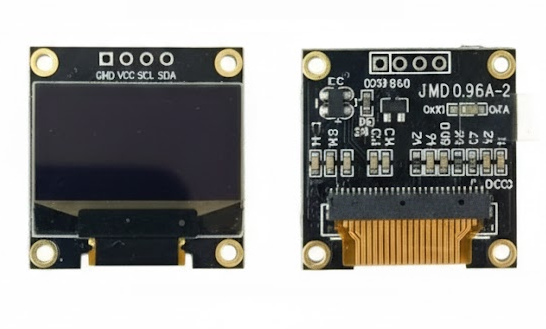
What Is a 0.96 Inch OLED Display?
A 0.96” OLED display is a passive-matrix organic light-emitting diode module, typically featuring a 128×64 resolution. Unlike LCDs, OLED pixels emit light independently, eliminating the need for a backlight.
This results in:
Higher contrast ratio
Faster response time
Wider viewing angles
Lower power consumption
These characteristics make 0.96” OLED displays ideal for information-focused interfaces rather than full-color graphics.
Key Specifications of 0.96” OLED Modules
Typical technical parameters include:
Screen Size: 0.96 inch
Resolution: 128 × 64 dots
Display Type: OLED, passive matrix
Color Options: White / Blue / Yellow+Blue
Active Area: Approx. 21.744 × 10.864 mm
Driver IC: SSD1306 or compatible
Operating Voltage: 3.3V / 5V
Operating Temperature: -40℃ to +80℃
These specifications make the module suitable for both industrial-grade and consumer-grade applications.
Interface Options: I2C vs SPI
Most 0.96” OLED modules support I2C and SPI interfaces, each with different advantages.
I2C Interface
Fewer signal pins
Easier wiring
Ideal for simple microcontroller projects
SPI Interface
Faster data transmission
Better for dynamic or frequently updated content
More stable for industrial systems
Engineers typically choose I2C for compact designs and SPI for performance-critical applications.
Typical Applications
Due to its size and performance balance, the 0.96” OLED module is commonly used in:
Industrial control panels (status indicators, menus)
Medical devices (portable diagnostic equipment)
Smart home controllers (thermostats, access panels)
Wearable and handheld devices
Measurement instruments and meters
Its readability in both bright and low-light environments makes it especially suitable for 24/7 operation devices.
Advantages Compared to Small TFT Displays
Compared with small TFT LCDs, 0.96” OLED displays offer:
No backlight required → lower power consumption
Higher contrast for text-based UI
Faster response time
Better visibility from wide angles
For applications that focus on text, icons, and simple graphics, OLED remains a more efficient solution.
Conclusion
The 0.96 inch OLED display module is a proven and reliable display solution for embedded and industrial applications. With flexible interface options, wide operating temperature range, and excellent optical performance, it is ideal for both prototype development and mass production projects.
If you are evaluating a display solution for your next design, the 0.96” OLED module is a strong candidate worth considering.
Call to Action
Looking for stable supply, clear specifications, or custom interface options for 0.96” OLED display modules?
👉 Contact our engineering team to discuss your project requirements and get technical support.